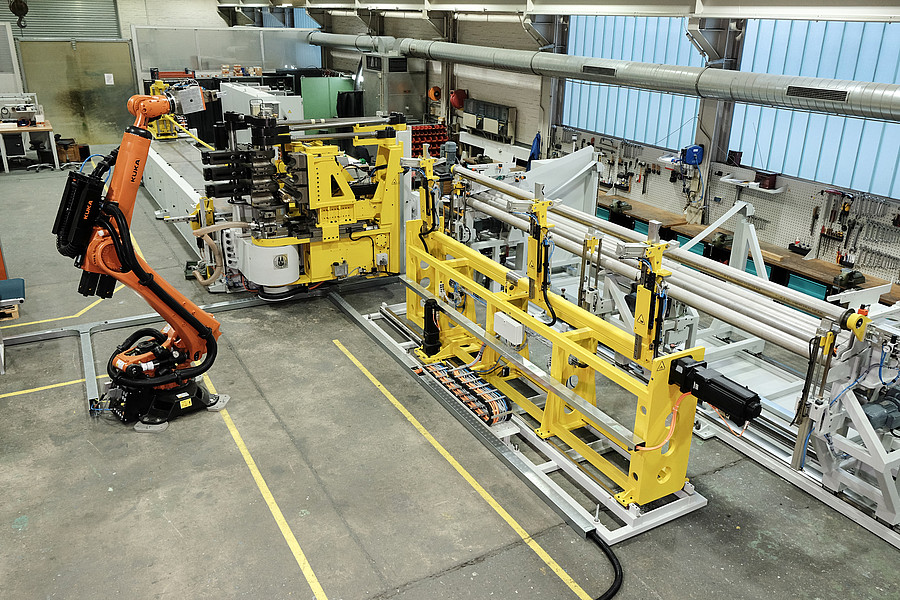

Tube bending instead of welding in shipbuilding – cost and labour in focus
Cost pressure meets skilled labour shortages
Shipbuilding is facing increasing cost pressure while simultaneously struggling with a shortage of qualified personnel. Skilled welders, in particular, are becoming harder to recruit and retain. This structural challenge is unlikely to ease in the near future.
As a result, manufacturing processes that rely heavily on manual welding are increasingly difficult to scale and control economically.
Welding as a labour‑intensive process
Welded pipe systems require numerous manual steps. Pipes must be cut, aligned, welded, finished and inspected. Each additional welded joint increases labour input, inspection effort and documentation requirements.
In an environment where skilled welding personnel are scarce, this dependency becomes a significant cost driver. Delays, rework and external inspections directly affect project budgets and delivery schedules.
Tube bending changes the cost structure
CNC‑based tube bending follows a fundamentally different approach. Through the controlled forming of the tube, the required geometry is created without joining multiple pipe segments. As a result, many welded connections can be reduced or eliminated entirely.
This not only shortens production time, but also reduces indirect costs related to quality checks, rework, and logistics for fittings and welding consumables.
Reducing dependency on scarce labour
A key benefit of tube bending lies in the significant reduction of manufacturing effort. While welding involves numerous process steps — from aligning components and performing the weld itself to cooling, finishing, inspection and documentation — the required tube geometry can often be produced through a single controlled bending process.
This can dramatically reduce lead times. While welding operations often require multiple skilled workers and additional inspection capacity, bending processes can be carried out with significantly lower labour input and, where appropriate, can even be largely automated.
Typical cost drivers of welded pipe systems include:
- high reliance on qualified welding personnel
- extensive inspection and documentation effort
- additional materials such as fittings and welding consumables
- cooling, setup and post-processing time
- rework caused by tolerances and alignment issues
Tube bending reduces or eliminates many of these factors, resulting in substantial time and cost savings.
Heavy‑duty bending technology as an economic prerequisite
To fully realise the advantages of tube bending in shipbuilding, manufacturers require bending technology that remains productive even under demanding conditions. Large diameters, thick‑walled pipes and challenging materials generate significant forces and loads. Standard bending technologies can generally handle such applications, but they often reach economic or productivity-related limits.
Heavy‑duty tube bending machines are specifically designed for these demands, delivering stable processes, repeatable results and high machine availability.
Another important economic factor is long-term machine availability. High-quality heavy-duty tube bending machines are characterised by robust construction, exceptional reliability and long service life. Unplanned downtime is minimised, maintenance intervals are predictable and production remains stable for years.
The investment therefore pays off not only through individual components, but through lower operating costs, high process reliability and long-term production planning security.
Conclusion: economic stability through decoupling
Tube bending does not replace welding in shipbuilding entirely. It replaces welding where cost, labour intensity and risk are highest. By reducing the number of welds, shortening production lead times and lowering labour requirements, manufacturers can significantly improve the economic efficiency of their fabrication processes.
Modern heavy‑duty tube bending machines provide the technical foundation for this approach. They ensure stable and reliable production, reduce the risk of downtime and help companies become less dependent on the availability of scarce skilled labour.
In an industry facing long‑term labour shortages, this decoupling becomes a decisive economic advantage.